Most childcare centres will tell you they're happy to support toilet training. What they won't tell you is that "support" can mean anything from diligently taking your child every 90 minutes to casually putting them back in a nappy the moment things get tricky.
That gap between what you expect and what actually happens is where toilet training falls apart for a lot of families. Not because your child isn't ready. Not because you did anything wrong. Just because home and childcare weren't on the same page.
Here's how to close that gap before it becomes a problem.
Talk to educators before you start, not after
The most common mistake parents make is starting toilet training at home over the weekend, then dropping their child at childcare on Monday morning with a bag full of spare undies and a hopeful look. Educators are not mind readers, and a rushed handover at the gate is not a briefing.
Book a proper two-minute chat, ideally with your child's primary educator. Cover these four things:
- Where you're at in the process (just started, a few weeks in, mostly reliable)
- How often you take them at home (every 90 minutes, after meals, when they ask)
- Any words or signals your child uses to tell you they need to go
- How you handle accidents when they happen (calm, no big deal, change and move on)
That last one matters more than people realise. If you're low-key about accidents at home but educators react with alarm or disappointment, your child picks that up fast. Consistent emotional tone across both environments makes a real difference to how quickly things click.
"I left a little note card in Hamish's bag with his toilet words and routine. His educator said it was the most useful thing any parent had ever given her." — Sarah, Geelong
What to pack in the daycare bag
Pack more than you think you need. Accidents cluster, especially in the first few weeks at childcare where the environment is stimulating and kids get distracted. Three to four full changes of clothes is a reasonable baseline. Five is not overkill.
Each change should include:
- Training underwear or pants (not pull-ups — more on this below)
- Shorts or pants that are easy to pull down quickly
- Socks (often forgotten, often needed)
- A labelled wet bag for soiled clothing
Avoid fiddly belts, buttons, or overalls during this period. Your child needs to be able to manage their own clothing independently when they get that sudden urge. The less they have to wrestle with, the better their chances of making it in time.
For underwear, a good set of training underwear is worth having multiples of. They feel like real undies so your child takes the process seriously, but they have enough absorbency to contain a small accident without it becoming a full clothing disaster. Sending your child to childcare in a 10-pack of training pants means you always have enough clean ones ready without doing washing every night.
Pull-ups at childcare: the honest answer
Some childcare centres ask parents to send children in pull-ups during toilet training. This is usually a staffing and workload issue, not an educational one, and it's worth having a polite conversation about it.
The problem with pull-ups is that they feel like nappies. Children know they can just go, so many do. The discomfort of an accident, which is one of the things that motivates learning, is removed. Pull-ups have their place (mostly overnight), but using them during the day at childcare can stretch the toilet training process out by weeks.
If the centre insists, ask whether training underwear with waterproof outer layers is acceptable as a compromise. Most educators are fine with this once they understand the difference.
Keeping routines consistent
Children learn toilet training through repetition and pattern. If home and childcare have completely different approaches, your child essentially has to learn two separate routines, which is harder than it sounds for a two or three year old.
The things most worth keeping consistent across both environments:
- Toilet timing (offer before meals, after waking from rest, before going outside)
- Language (use the same words your child knows)
- Response to accidents (calm, practical, no shame)
- Expectations around asking (do you wait for them to tell you, or prompt proactively?)
Ask the educators at pickup how the day went. Not just "any accidents?" but specifically: did they seem to know when they needed to go, were they telling educators before or after, how were they going with pulling their pants down themselves? This gives you real information to work with at home.
"The kindy teachers started doing the same countdown we do at home — 'last wee before we go outside' — and it made such a difference. She stopped having accidents at pick-up time completely." — Mel, Brisbane
Rest time and naps at childcare
Many childcare centres still use nappies or pull-ups for rest time, even for children who are otherwise toilet trained during the day. This is a reasonable short-term approach, but worth revisiting once your child is reliably dry for most of the day.
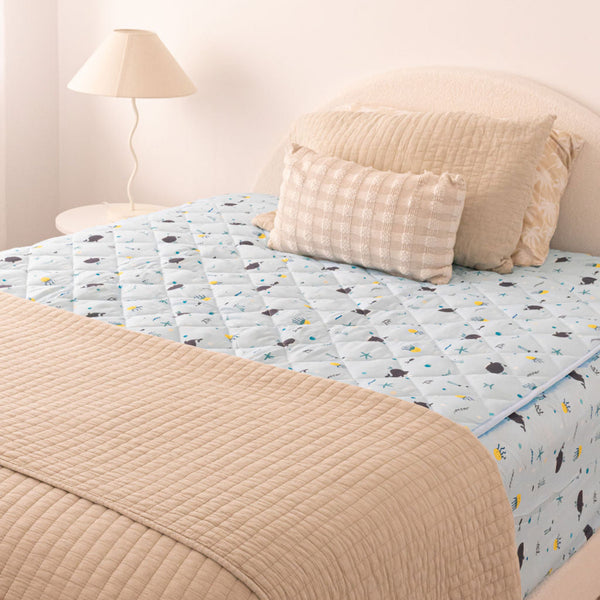
If your child sleeps on a mat or cot at childcare, ask what protection they use on the bedding. A leakproof fitted sheet on their home bed during this phase protects the mattress and makes middle-of-the-night changes much easier. For the childcare mat, most centres have their own protection, but some parents bring their own fitted cover during the transition period.
When it's not working at childcare
If your child is doing well at home but consistently having accidents at childcare, it's rarely a sign they're not ready. More often it's one of these:
- The environment is too stimulating and they lose track of body cues
- They don't feel comfortable asking an educator they don't know well
- The childcare toilet setup is unfamiliar or slightly scary (loud flush, no step stool)
- Educators are stretched and toilet trips are being missed
Work through these one at a time before assuming the timing is wrong. Most are fixable with a conversation or a small adjustment to routine.
The flip side also happens: children who seem ready at home suddenly show big leaps at childcare because of peer modelling. Watching other kids use the toilet casually, without drama, is powerful. Don't underestimate it.
The short version
Brief your educators properly before you start. Pack more changes than you think you need. Keep the language and routine as consistent as you can across home and childcare. Stay calm about accidents on both sides. And check in at pickup with actual questions, not just "how was their day?"
Toilet training at childcare works best when it feels like a shared project, not something parents are doing at home that childcare is just tolerating. Most educators genuinely want to help. They just need to know how.
Browse the full toilet training range if you're stocking up for the daycare bag.